 Distribution
Pilea peperomioides is native to the China South-Central region, thriving naturally in this area.
It has also been introduced to regions such as Belgium, adapting well to diverse environments globally.
 Care
Care
Learn how to care for Pilea peperomioides when keeping it indoors.
Each topic has an in-depth guide that you may read to get more information.
Light


No light information is available for this plant species.
Watering
Water your only when the top layer of the soil feels dry. If it is still moist, no further watering is needed.
Use a well-draining pot and make sure that the roots of the plant do not stand in water for extended periods of time to avoid root rot.
Temperature
Pilea peperomioides prefers temperatures between 15°C and 28°C.
15°C - 28°C
1°C = 33.8°F
Soil
Use a slightly acidic soil with a pH ranging between 5 and 6.
5 - 6
lower pH = more acidic
higher pH = more alkaline
Propagation
You can propagate this plant asexually using one of these techniques.

layering

rhizome division

leaf cutting
 Additional Info
Flowers
Under the right conditions, Pilea peperomioides is able to produce flowers.
Toxicity
Pilea peperomioides is known to be safe for pets.
Propagation by seperation
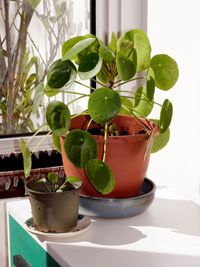
This plant produces plantlets (often called offshoots) from underground shoots. These offshoots may be cut off and easily propagated.
 Sources
Wikipedia | The Free Encyclopedia
https://en.wikipedia.org/wiki/Pilea peperomioides
Kew | Plants of the World Online
https://powo.science.kew.org/results?q=Pilea peperomioides
GBIF | Global Biodiversity Information Facility
https://www.gbif.org/search?q=Pilea peperomioides
